

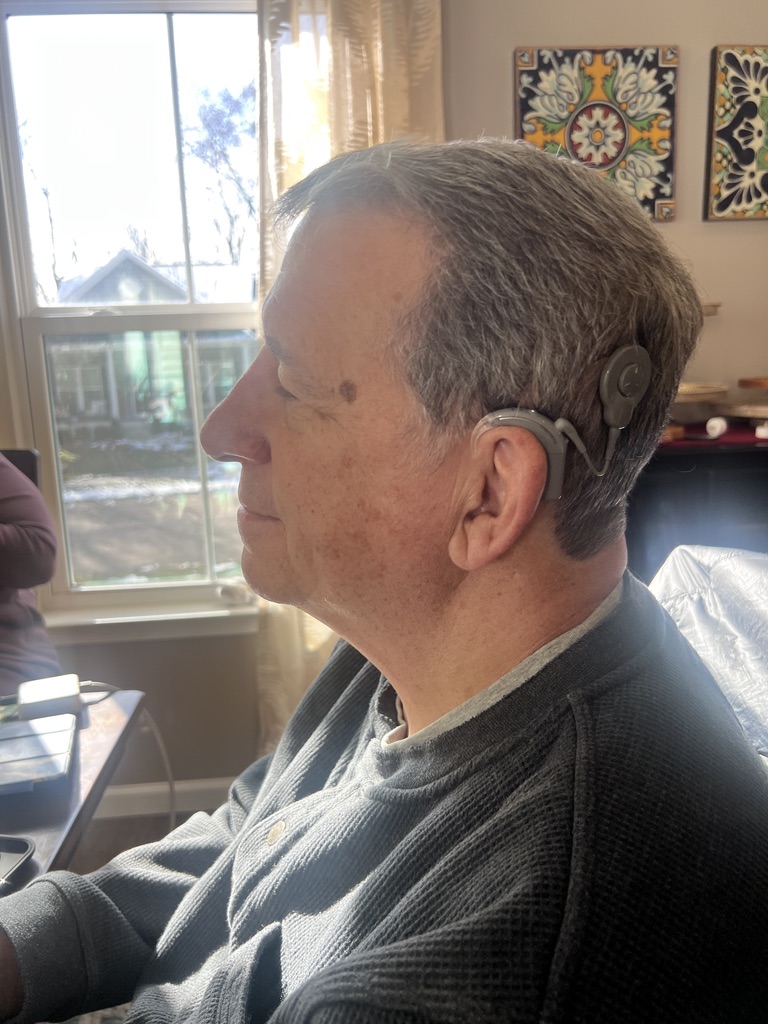
For twelve years I suffered with Ménière’s disease. It robs you of normal hearing, many times eliminating actual hearing, and leaves you with another condition called tinnitus. Then it adds the coup de grâce of robbing you of your balance, often putting you in a state of vertigo.
In 2014 they diagnosed me with idiopathic endolymphatic hydrops — the clinical name for Ménière’s disease. For two years after that I avoided getting hearing aids. My rationale was sound (pun intended): even what I heard I couldn’t decipher anymore. My left ear kept about 30% hearing ability, but the reality was 0% word comprehension. My whole world was taken. The fear of losing the second ear’s capabilities, and how much of the life I’d built would go with it, was incomprehensible! And it often happens to people afflicted with this condition. So why hearing aids? Despite the lack of academic and medical evidence, it eventually dawned on me that a hearing aid might actually ease my vertigo and balance issues. I’d noticed the acoustic pressure in my left ear — yes, sound induces a pressure — wasn’t the same as my right. That put me on a path to find out if volume was the culprit. So I condescended to a hearing aid in 2016, after a violent episode of vertigo in the workplace. Yes, it involved projectile vomiting and an ambulance ride. Something needed to change.
When they activated my hearing aid, the most miraculous thing happened — the acoustic pressure equalized immediately. It did nothing for the atmospheric pressure effects that also hit my balance, but it was a great start. Over a few months I returned to something much closer to a normal life, vertigo mitigated. Balance on my feet was still an issue. Interestingly, balance never troubled me driving or riding my bike. I was overjoyed. I’d gotten back part of my life I’d lost, and I was so grateful for it.
My hearing in that left ear kept declining, even with hearing aids, and I had to accept there’s no training that compensates and helps you hear better. Working alone or one-on-one on a phone call wasn’t an issue, but another problem was hitting my work. In 2020, during COVID-19 days, I was a Director over a $20M government agency. I had a staff of PhD and Masters professionals at my disposal, and I met constantly by phone, TEAMS, and ZOOM. Masks imposed a reality on me — with only one viable ear you don’t just hear half of what you’re used to, you also can’t triangulate sound. I found myself constantly asking people to repeat themselves. If it annoyed me, it annoyed and impeded others. I was convinced it cut my competence at work, and it certainly hit my confidence and self-esteem. Add the pressures of caring for infirm and failing parents in Florida while living and working in Ohio, the regular pressures of work, the constant lack of integrity in the government response to the pandemic, and several other pressures — and in a moment of clarity I decided I’d done enough and could retire. I’d served with integrity, principle, and success. I was proud of my accomplishments, but caring for my own failing faculties needed to come first. So I retired, and we began our Adventures in Epsilon. I won’t look back.
Insidious as the disease is, though, it wasn’t done. My failing faculty made me avoid noise, and especially crowds. If you know the size of my family, that means being around them was getting difficult — they number six at a minimum when together. I couldn’t stand worship services or concerts either, and I really couldn’t handle talking to more than two people at once. Remember, I still couldn’t triangulate sound. So I withdrew from having company, from socializing, from my family.
One day I woke up. I thought through my readings — how infirm and short-lived people become when they lose hearing alone, and how a lack of socialization shortens life too. I began exploring a permanent solution: a cochlear implant. I’d first heard of the idea years earlier. Thinking it over, I feared the surgery, and feared something going wrong and permanently costing me even what I had, which was terrific relief from vertigo. My original plan was to save this option for a more advanced age when the technology would be much improved. After all, you can’t change much once you’ve had that surgery! But exploring it with my VA audiologists, they told me two things that held my attention. First, I might qualify for the surgery now, but continued decline of my left vestibulocochlear nerve could eventually disqualify me, because the implant would no longer be effective. Second, the surgery itself is routine and outpatient, and the improvements in people’s lives are spectacular. They cautioned me about a lot — how long it might take to enjoy music (spoiler: I still may not get to where it’s more enjoyable, but I have hope), how limited it might be in producing the results I hoped for, and that it may or may not eliminate the 24/7 tinnitus that plagues me. I’m happy to report no tinnitus when I’m wearing the processor! A real bonus — you just don’t realize how much that constant noise wears you out.
I’m grateful to everyone posting their cochlear surgery experiences on YouTube. Watching them come through successfully emboldened me to do the same. So I decided, and went through the testing to show I was still a real candidate for the device. The surgery was a breeze. I felt no pain until later, recovering from the incision without any painkillers, and even then it was trivial. A month later I was ready for activation.
“I hear static when the magnetic field engages the external processor’s magnet.” That was my first experience. Then they turned it on. My friends, tears of joy streamed down my face — I remember it vividly. It was like the entire left side of my body came back to life with sensation. Where I’d been numb, I was living now, with unbridled sound permeating my head and limbs on that side. It was one of the few stunningly joyous moments of my life! I could hear. I could hear! A second blessed miracle for my life — I survived cancer at 39 as well.
There’s a two-year journey after activation that brings you to your personal optimal state. I may not get my natural hearing back, but maybe I’ll reach 100% word recognition, or 100% sentence recognition. I’ve already returned to a limited ability to triangulate sound. And most importantly, I can get back to enjoying socializing. So I do. I wonder if my caravan friends will notice a before-and-after difference? Colleen has. I’m alive again.
The lesson: I shouldn’t have waited. Had I not, I might have held on to the best job I ever had as that Director. Or maybe something greater. Yet in the personal economy of life, it’s truly enough. And it’s an experience I’ll recall if I’m ever on my deathbed awaiting my delivery to Jesus. I’ll be comforted by that recalled feeling of being alive again. And in that moment I’ll be only a moment from realizing it was nothing compared to what’s ahead.
Many blessings to you, Beloved Readers!
Featured photo of Epsilon under Mount Drum by Tom Beattie.


Leave a comment